February 13, 2026
Know the two-system approach to trailers and RVs. I’m going to use 12 V DC for lights, brakes, pumps, and controls and 120 V AC for appliances via shore power or inverters.
Verify clean, secure connections at the plug and ground points. Check for corrosion. Check pin functions with a multimeter, and be sure the tow vehicle and trailer have similar amperage and voltage ratings.
Construct and preserve a suitable wiring harness. Select the appropriate wire gauge and insulation, adhere to industry-standard color codes, and label circuits clearly for quicker debugging.
Avoid typical breakdowns with regular inspections. Check for abrasion, moisture, and loose terminals. Put on dielectric grease and secure harnesses to prevent vibration fracturing.
Troubleshoot systematically to save time. Begin with a visual inspection, then test the connector and grounds. Isolate circuits and keep a log of results and repairs for future reference.
Design for future upgrades securely. Anything you’re augmenting with solar, lithium batteries, or smart controls requires upgrading breakers, wiring, and converters as necessary. Bring in a qualified RV electrician for tricky work.
Trailer electrical systems offer power for lights, brakes, charging, and onboard gear via a 12 V circuit connected by plug and wiring harness. Typically, they use a 7-pin connector for tail, stop, turn, reverse, and brake control as well as ground, with small trailers using 4-pin. Key components are the tow vehicle’s alternator, a brake controller, fuses and relays, and a grounded frame. Typical components are copper wire with PVC jacketing, heat-shrink joints, and weatherproof housings rated to IP67 or above. In general, the wire sizes go from 1.5 mm for lights to 6 mm for brakes and charge lines. To reduce faults, they test continuity, freshen grounds, and seal splices. The following sections outline components, wiring routes, and servicing procedures.
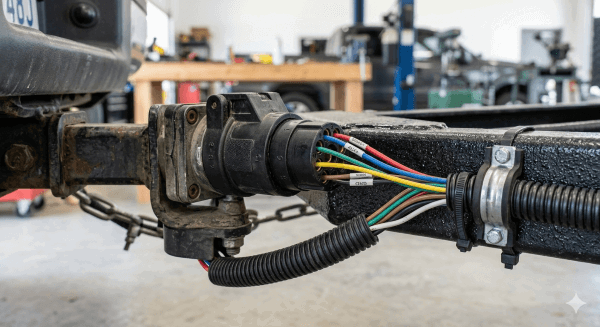
Trailer electrical systems power route from sources to end devices via plugs, harnesses, protection gear, and grounds. Most trailers use 12 V DC for lights and brakes. RVs incorporate 120 V AC for outlets and large loads. Circuit breakers, fuses, and distribution panels protect both sides.
Trailers draw power from three places: onboard 12 V batteries, the tow vehicle’s alternator through the connector, and 120 V shore power at campsites. Others will add a bit of solar as a charge source integrated into the battery bank.
A 12 V battery powers marker lights, brake magnets, water pumps, control boards and fans. Shore power (120 V AC) supplies outlets, chargers, air conditioners and microwaves. A converter/charger converts AC to 12 VDC to maintain battery fullness.
A separate 12 V system is essential for operating lights and electric brakes while towing. It maintains safety equipment energized in the absence of AC power.
Check battery polarity, fuse at battery positive, clean tight lugs. Monitor electrolyte levels, state of charge, and cable condition so power remains throughout the trip or campground.
Typical plugs are 4 pin flat (basic lights), 6 pin round (adds brakes/aux), and 7 way RV blade. The 7-way RV blade standard is pretty much universal and works with nearly all tow configurations globally.
Pins map to core functions: tail/running lights, brake lights, left and right turn signals, electric brake control, ground, and auxiliary 12 V feed. At the very least, all trailers require four functions: tail, brake, left, and right.
Keep plugs locked clean and dry for solid contact. A. Make sure voltage and amperage ratings match between tow vehicle and trailer. If you run electric brakes, verify your brake controller output.
Trailer wiring, called trailer harness, refers to the electrical wiring that powers the different functionalities required to tow a trailer. It’s the grid that delivers current and commands from the plug to each piece of equipment.
Use proper gauge to limit voltage drop: thicker wire for brakes, charge lines, and long runs. Select insulation rated for abrasion, heat, and moisture.
Use RV wiring conventions and color codes. On the old 7-way RV blade, brown is for taillights. Black provides 12 V constant on the 7-way blade and the 6-way round. Make a legend of circuits and wires for fast fault finding later.
Fasten, wrap in loom and protect the harness from road spray and sharp edges. Add grommets where it goes through metal.
A solid ground completes each circuit and reduces noise. Bond the ground wire to clean, bare metal on the trailer and tow vehicle with star washers.
Weak grounds make for dim or flickering lights and random dropouts. In brakes, bad return paths translate to weak braking or no braking at all.
Check ground lugs frequently for rust, paint creep, and loose bolts. Swap corroded ring terminals and inject dielectric grease if permitted.
End devices consist of trailer lights, electric brakes, backup lights, interior lamps and charge lines for batteries. If you have electric brakes on your trailer, make sure trailer wiring is compatible and in sync with your vehicle’s brake controller.
Power requirements are different. Lights, pumps, and other devices operate on 12 V. HVAC compressors and microwaves pull 120 V AC. Control boards often remain on 12 V even if the appliance is AC.
Newer RVs can throw in power awnings, solar panels, and energy management systems that distribute loads between AC and DC. For complicated builds, 7-pin connectors are best.
Utilize proper connectors, fuses, and breakers sized to each piece of equipment. Include a basic wiring schematic in your kit that indicates plug pins, wire colors, branch points, grounds, and auxiliary lines for quick field repairs.
Trailer electrical failures often trace back to a few root causes: bad wiring, corroded connectors, weak grounds, and moisture. Voltage drops, wrong wire size, dirty contacts, and poor battery care put extra stress on your system. Overloads, short circuits, or ground faults can trip fuses and breakers. Tow vehicle and trailer gear voltage mismatch can stress lights and brake controllers. Under-sized gauge RV wiring overheats, melts insulation, and causes intermittent faults.
Common issues and symptoms:
|
Issue |
Likely Cause |
Symptom |
|---|---|---|
|
Dim or flickering lights |
Corrosion, voltage drop |
Unstable brightness |
|
No brake lights |
Ground fault, blown fuse |
Dead circuit |
|
Intermittent power |
Loose/dirty connector |
Works, then cuts out |
|
Breaker trips |
Overload/short |
Power loss, hot wires |
|
Battery won’t hold charge |
Poor charging, self-discharge |
Low voltage after rest |
Moisture, road salt, and dust attack plug blades and sockets. Oxides act as a barrier, increasing resistance and heat, which then exacerbates the corrosion cycle.
Check for green or white residue inside 7‑pin or 13‑pin sockets. That flicker suggests bad contact and a voltage drop under load.
Clean with contact cleaner and a nylon brush, then put dielectric grease on pins to inhibit oxidation. Swap out any melted housings. If the metal is pitted or the spring tension is weak, switch out the connector to maintain stable power flow.
Loose, broken, or rusted grounds are a prime fail source. Flickering lamps, humming relays, and fading electric brakes frequently indicate bad ground return. Check continuity with a multimeter from the ground pin to the trailer frame. It should be near 0 ohm.
Record all grounds in a wiring diagram. It accelerates post-repair inspections and aids in capturing overlooked bonds.
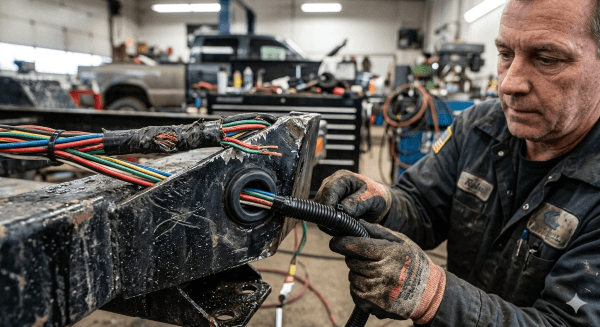
Wires rubbing on sharp edges, axle travel, or tongue pivots can chafe to copper. That results in shorts or open circuits and can trip breakers quickly. Use split loom, grommets through metal, and solid clips every 12 to 18 inches. Check hinge points, crossmembers, and junction boxes for nicked jackets. Replace or heat-shrink fix damaged runs before they arc or catch fire.
Water in connectors, junction boxes, light housings, or harness splices beckons shorts and corrosion. Seal with weather boots, heat-shrink with adhesive and IP-rated glands. After rain or washing, inspect for fogged lenses or wet panels. Dry, then reseal.
Keep batteries healthy: flooded lead-acid need monthly water checks. Many 12-V units fail early due to poor upkeep. Storage self-discharge can reach about 10% per month, so a three-stage charger or maintainer is necessary. Dirty or loose connections and incorrect gauge wiring drive amperage, trip protection, and can fry components.
Constant vibration that travel induces accelerates wear in trailer electrical systems and shakes fasteners loose. Wire ends out of terminals can creep out, causing flicker or dropouts or a dead circuit. Apply locking connectors and vibration‑resistant hardware at axles, hitches, and suspension mounts. Check wiring following lengthy journeys, unforgiving terrain, and winter haul routes. Michigan conditions tend to exacerbate several vibration culprits.
Repeated flex and shock loosen screw terminals, spade connectors, and plug pins. It manifests itself in hot spots, flickering lights, or ABS faults post bumps.
Torque check screw lugs, spade fit with a good tug and 7-pin and 13-pin for pin recession or spread sockets during maintenance. Put thread locker on studs, star washers under ring terminals and latch-type connectors in high motion areas.
Checklist for inspections:
Battery posts, shunt blocks, and main negative bus
Junction box barrier strips and ground studs on frame
Brake magnet leads and axle junctions
Trailer plug pins, breakaway switch, and charge line connector
Light housings, marker lights, and license plate lamp
Inverter/charger input and output blocks, solar charge controller terminals
Document any loose point and recheck after 200–300 km.
Vibration causes wires to chafe on metal flanges, wood ribs, or fastener tails. Check around such areas as cross members, pass-through holes, spring hangers, and where looms cross frame edges.
Re-route from edges. Use zip ties with cushion clamps every 200 to 300 mm. Leave a little service loop near hinges and slide-outs to reduce strain.
Throw in split-loom, PET braid, or PVC conduit in high-hazard runs. Grommet all bulkhead holes and deburr edges first.
Highlight chafe-prone areas on the wiring diagram and label the loom with heat-shrink labels for fast follow-ups.
Switches, relays, breakers, and lamp sockets wear from cycling and shock. Contacts pit, coils become loose, and housings can crack, causing nuisance trips.
Swap out aged or noisy relays, spongy breakers and corroded lamp bases prior to failure. Track age and cycles in a log. Note install date, estimated cycles per week, ambient heat and vibration exposure.
Carry spares: blade fuses (common ratings), a relay pair, spare bulbs/LED modules, and one breaker. Vibration resistance tests are often stated with reference to frequency and peak acceleration, something like IEC 60068‑2‑6 (sine) or IEC 60068‑2‑64 (random) methods, generally applied in three axes over ranges. Heavy, slow machinery may sit at 10 to 55 Hz at approximately 2 g, and rockets experience 10 to 2000 Hz at up to 20 g. Trailers are somewhere in the middle, although some sets experience little screen time.
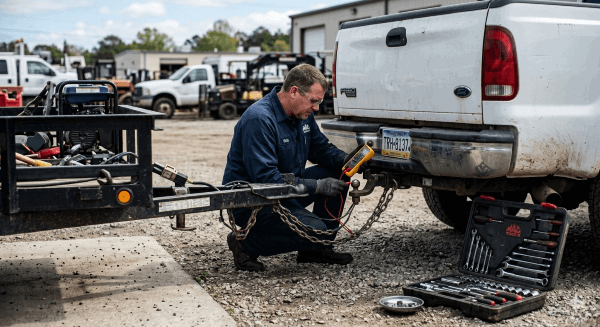
Begin with security. Park, wheel chocks, shore power off, take jewelry off. Know your system: trailers and RVs use 12 V DC for lights and controls and 120 V AC from hook-up or generator for appliances. Fuses and circuit breakers first. On lots of RVs, the breaker panel can hide under a seat, in a cabinet, or next to the converter. Test campground outlets with a polarity tester before you plug in. Keep a test light, a multimeter (solid models run $40 or less), and your wiring diagram handy. Proceed systematically, isolate one circuit at a time, and record your steps.
Scan the harness from the tow plug to each light. Check for crushed insulation around frame clamps, pinched wires at grommets, and rubbed places at hinge points. Burnt or melted jackets suggest overloads or shorts. Inspect plugs and sockets at the truck/trailer junction, as bad contact commonly masquerades as a wiring defect.
Corrosion at ground lugs and battery posts is a frequent culprit of dim or erratic lamps. Loose terminals at junction boxes or 7-pin sockets cause intermittent loss of turn signals or brakes. On hybrid 50-amp to 30-amp configurations, check that adapters are clean and tight.
Frayed, cut, or abraded insulation
Burnt, melted, or discolored wires and housings
Loose, green/white crusted, or wet connectors
Broken lamp sockets, cracked housings, missing gaskets
Chafing at frame holes; missing grommets or clips
Signs of heat at fuse holders, relays, or the converter.
Test light or multimeter to verify voltage and continuity at each pin on the trailer plug. Check readings against your wiring diagram for running lights, left/right turn, brake, reverse (if used), electric brakes, ground, and auxiliary 12 V feed. Make sure 12 V DC is steady with lights on. Wiggle plug to expose intermittent faults. Log each pin’s value and behavior under load.
Ground needs to be a low-resistance path. Check resistance from trailer ground pin to frame, then conduct a voltage drop test under load from ground terminal to frame. If resistance is high or the drop is more than about 0.5 V on 12 V circuits, clean paint and rust, tighten hardware, add star washers, or run a dedicated ground wire. Mark every ground point on your schematic for rapid checks later.
Remove a fuse or two at a time. Open a branch at a junction box until the fault clears. If you have jumper leads, bypass a suspect section or feed a lamp directly from the battery. If it works, the harness run is bad. Once a short is located, replace blown fuses or reset breakers only after the cause is repaired. For 120 V, check shore power with a polarity tester, gauge adapter sizing (50-amp to 30-amp, etc.), and isolate AC from DC faults to prevent cross chasing. Write down the component that failed, where it was, what you fixed, and the test results.
Establish a hard cadence mixing everyday walk-arounds with deeper monthly and quarterly checks. Daily and periodic checks can catch early wear from water, dust, road grit and rough handling. Fold in seasonal changes—monsoon, winter, heat waves—so parts get cleaned, dried and sealed as weather shifts. Consider proactively maintaining other items like brakes (electric or hydraulic), tires, seals and wheel bearings in addition to the electrical system since those faults often overlap.
Daily: Quick visual of lamps, plug, breakaway battery indicator, wiring sag, and tire pressure in kPa.
Weekly: Test all lights, verify ground continuity, look for chafe points, check junction boxes, brake lead wires, and hub temperatures after a short run.
Monthly: Open connectors, clean and grease. Torque ground lugs. Inspect loom, mounts, and grommets. Measure battery voltage, both resting and under load. Check fuse and relay seats.
Quarterly: Pull light housings, reseal gaskets, inspect brake magnets and wiring, repack wheel bearings, balance tires, and confirm charge line output from tow vehicle.
Annually: replace worn plugs, cracked housings, brittle loom. Load-test batteries. Update labels. Refresh training on lockout/tagout and safe testing.
Train drivers and techs on basic care: identify corrosion, spot loose or nicked wires, use a multimeter safely, and log faults. Immediate repairs prevent galvanic and chemical reactions that cause rust and costly damage.
Apply electrical contact cleaner to plugs, connectors, and terminals to remove grime and oxide. Cleaning your equipment on a regular basis washes away the grime that accumulates over time and can inhibit current flow.
Wipe battery posts and use anti-corrosion spray to help slow sulfation and prolong service.
Open junction boxes and lamp housings to clear debris and moisture. Change cracked gaskets as necessary.
Incorporate cleaning into your pre- and post-trip routines along with some additional love after rain, road salt, or unpaved hauls.
Use dielectric grease on all connectors to shed water and prevent corrosion. Apply it to battery terminals, trailer plug pins, fuse holders and breakaway switch leads for wide-ranging coverage. Reapply following any cleaning or repair because solvents deglaze strips. Have a tube in the field kit for quick repairs in bad weather.
Secure the harness to the frame with padded clamps, mounting headed zip ties, or cable trays. Stay away from moving parts, sharp flanges, suspension travel paths, and heat sources such as exhausts.
Tag branches close to junctions to speed up fault tracing in night or roadside work.
Check supports frequently, swap out missing clips and used loom. Inspect tire pressures, brake components, seals, lubricants, and electrical circuits all at once. Apply heavy-duty lubricants to moving parts and service electric brakes for reliable stopping.
Modern trailer and RV electrical systems run two paths at once: a 12-volt DC circuit for core loads and a 120-volt AC circuit for higher-draw gear. These are separated for security but cooperate. The 12-volt side supplies lights, fans, pumps, control boards, and USB ports from one or more batteries. The 120-volt side powers air conditioners, microwaves, induction cooktops, and TVs. When you hook up to shore power, the 120-volt panel is energized and the 12-volt bank charges through a converter/charger. Battery banks usually charge in three ways: through the converter on shore power, through solar panels using an MPPT controller, or through a generator.
Smart monitors and lithium batteries and solar all change how these systems operate. A battery monitor with shunt provides real-time state of charge, more accurate than a voltage guess. Bluetooth charge controllers and smart alternator DC-DC chargers balance inputs without overcharging. The LiFePO4 batteries provide deep cycles, rapid charge rates, low weight, and stable voltage. They require a charger with a lithium profile and low-temperature protection. For moderate off-grid use, a standard 200 to 400 Ah lithium bank goes great with 400 to 800 W of solar. Most modern systems use inverters, which convert 12-volt DC to 120-volt AC for short spells, but a 16 A or 30 A shore plug will always beat an inverter. Heavy AC loads will empty batteries quickly.
Extra juice, extra upgrades. Select proper cable size according to run length and current. Many long DC runs to inverters require 35 to 70 mm2 with proper lugs and heat‑shrink. Include main breakers and fuses sized to protect wire, not devices. Install a transfer switch for quick, safe changeover between shore, generator, and inverter. Select a good quality converter/charger or inverter‑charger with multi‑stage charging and programmable profiles. Test the campground pedestal with a polarity tester before you plug in to guard against reversed hot/neutral or open ground. Maintain the system: label circuits, check torque on lugs, test RCD/GFCI outlets, and reset or replace weak breakers and fuses.
|
Consideration |
What to check |
Benefit |
|---|---|---|
|
Lithium batteries |
Charger profile, temp cutoff |
Higher usable capacity, fast charge |
|
Solar + MPPT |
Array size, shading, tilt |
Quiet charge, less generator time |
|
Wiring size |
Cable gauge vs. amps and length |
Lower voltage drop, less heat |
|
Breakers/fuses |
Correct rating, DC/AC type |
Fault protection, fire safety |
|
Inverter sizing |
Surge rating, duty cycle |
Stable AC for key loads |
|
Pedestal test |
Polarity tester use |
Prevent damage, shock risk |
|
Pro help |
RV electrician for custom work |
Code‑safe installs, fewer faults |
For trickier installs, hire a seasoned RV electrician who knows local codes and best practices.
To sum it up, trailer power thrives or dies based on small habits. Clean ground points eliminate noise. Tight lugs prevent heating. New loom protects wiring from abrasion. Short, clear runs make it easier to trace faults fast. A small kit in the box saves a long tow: test light, spare fuses, heat shrink, zip ties, a crimper, and extra bulbs. For new gear, opt for sealed lights, molded plugs, and brake controllers that have easy-to-read displays. Hook up a surge guard if you tow in rain or salt.
Real wins show up on the road: steady brake pull on a long grade, bright tails in fog, no dead plug at night. Need a fast action item! Take a 10-minute check with the guide and log the results.
A trailer electrical system consists of the battery, wiring harness, connectors, lights, fuses, relays, breakaway system, and sometimes a controller. Each piece has to correspond to your tow vehicle and load. Safe operation and reliability depend on good grounding and firm connections.
They typically emanate from bad grounds, corroded connectors, damaged wiring, blown fuses, and vibration-induced looseness. Salt and moisture accelerate corrosion. Wrong wire gauge or overloading circuits wreak havoc. Routine inspection avoids most failures and keeps lights and brakes reliable.
Vibration loosens terminals, rubs insulation and breaks strands over time. It puts stress on lamp filaments and LED boards. Strain reliefs, grommets, loom, and adhesive-lined heat shrink are important. Anchor harnesses at close intervals. Opt for connectors designed for vibration rating to increase service life and minimize unscheduled outages.
Begin with the tow vehicle fuse. Verify frame ground. Test the 7-pin or 4-pin plug with a multimeter. Check bulbs or LEDs and check for broken wires around the tongue and lamps. Make sure you clean and reseat connectors. Fix with waterproof splices.
Check wiring and connectors on a monthly basis. Clean and dielectric grease plugs. Check grounds, fuses, and breakaway battery health. Change out cracked loom and worn grommets. Test the lights and brakes before each trip. Secure harnesses taut and guarded to avoid irritation and water intrusion.
Yeah, generally. LEDs pull less current, resist vibration, and last longer. They minimize draw on circuits and maximize visibility. Go for sealed, IP-rated units and coordinate voltage and connector types. Good grounding and quality installation are key to getting the most out of them.
Ensure they’re compatible with the tow vehicle’s electronics. Use appropriate interface modules for CAN bus. Keep clean, low-resistance grounds. Safeguard circuits with appropriate fuses. Use manufacturer wiring diagrams and torque specs. Professional inspection avoids faults and false warnings.
Still looking for answers? Browse DMR Diesel’s resource library for practical insights on diesel engine repair, trailer wiring issues, fleet maintenance, and heavy-duty truck diagnostics.
Looking to learn more about trailer safety and electrical systems? Explore trusted resources from transportation authorities.
Alberta Vehicle Equipment Standards